



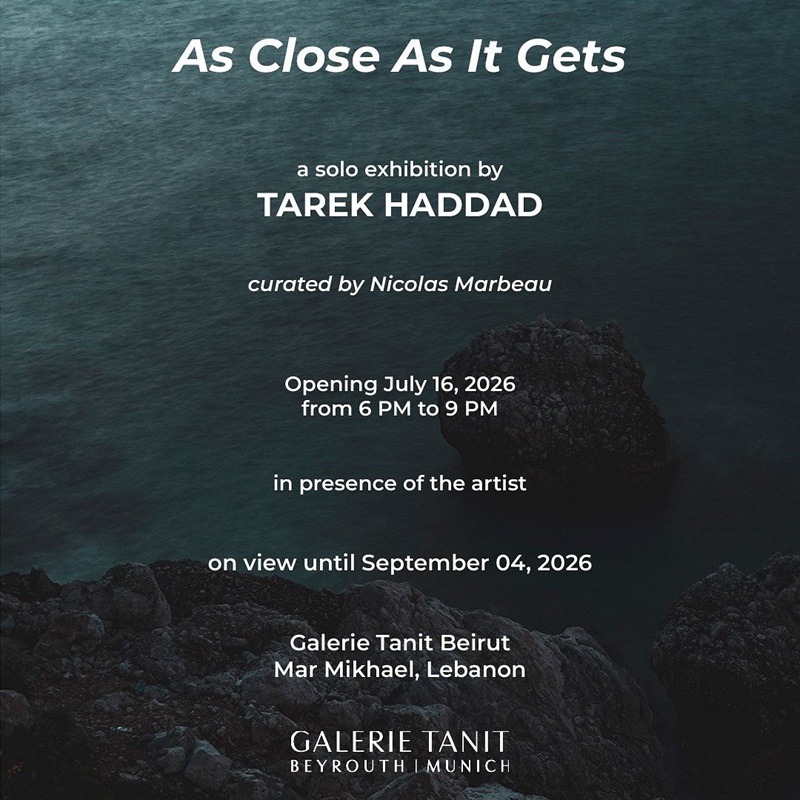
As Close As It Gets, Tarek Haddad
Deconstruct, reconstruct. What Tarek Haddad seeks seems attainable only through alteration.
Relentlessly, he works his images, distorting and transforming them. Emerging from his vision of the world is a fragmented biography: Lebanon, departures to France and Finland—both chosen and imposed—and his eventual return.
From these successive displacements, he extracts a photographic material that becomes tangible, something that can be handled and manipulated. The images themselves become surfaces upon which he intervenes with methodical precision. First through observation, which gives rise to doubt: what are we looking at? Are these truly landscapes—seas, mountains? Or are they objects through which he reads a distant present? Then comes addition: a ruler measuring the world and imposing form; stones carefully placed upon a print that seems to sink inexorably until image and object become indistinguishable. Finally comes reorganization—the ordering of a universe where sea, cubes, and pixels coexist, and the microscopic becomes monumental.
Tarek Haddad knows that this method is ultimately destined to fail. Control continually slips away. What he seeks remains out of reach, while what has been forgotten—what lies far from home—may already have disappeared. His obsession begins to reveal itself everywhere, as though the world were caught in a state of disorder that he persistently attempts to arrange.
Perhaps it is precisely within these images that he finds a place to belong. Is studying these landscapes a way of recovering an origin, or of escaping it? They are no longer records or specimens of places, as painters once brought back from working directly in the landscape, but works concerned with memory, where each element becomes either a recollection waiting to be recovered or a memory still in the making.
Data continues to accumulate—a landscape transformed into a data center, where every possible configuration coexists as fragments held in suspension.
Originally trained in computer programming, the artist inherits the legacy of nineteenth-century photographers, who were above all scientists. His practice no longer relies solely on light itself, but on the way light inscribes a surface—from silver gelatin paper to the digital sensor. The traces of these photosensitive impressions—digital waves that pass, transform, and fade—do not reproduce the world. Instead, they offer another version of it: unstable, fragmented, and perpetually renewed. As though the image were the only territory to which he can still return.