




Renowned for his uncompromising vision and brazen designs, Bernard Khoury is the architect who builds where others dare not. We enter the world of one of Lebanon’s most prolific creative forces to trace a journey that spans family legacy, war and resurrection.
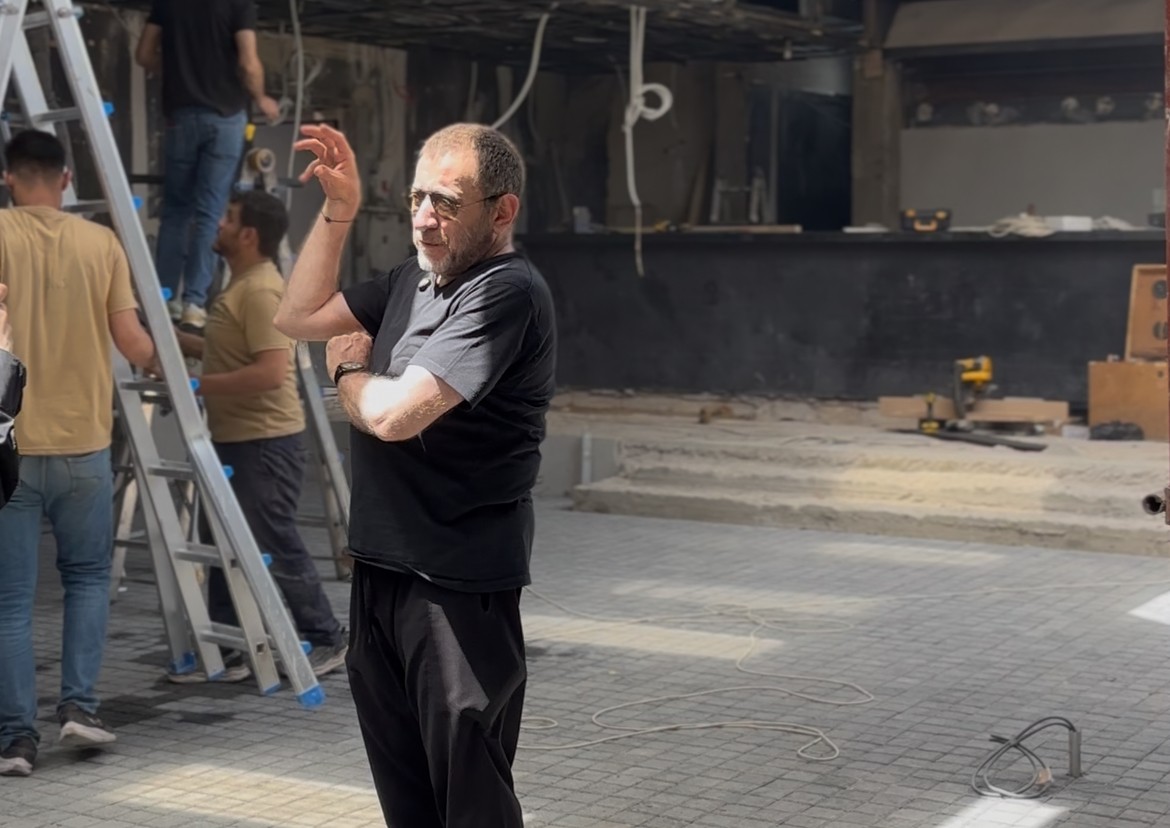
Bernard Khoury did not choose architecture so much as inherit its DNA. His father, Khalil Khoury, was one of Lebanon’s most remarkable creative figures — a designer, manufacturer and industrialist — who, in the late 1950s and early 1960s, embodied an audacious vision of modernity that, as Khoury puts it, would be “absolutely impossible today to even conceive of.” Khalil designed the furniture, built the machines to produce it, designed the factory that housed those machines and designed the showroom in which the finished pieces were exhibited. The graphics for the catalogs were produced in-house. The photo studio was in-house. It was a complete creative universe, conceived and controlled by one man.
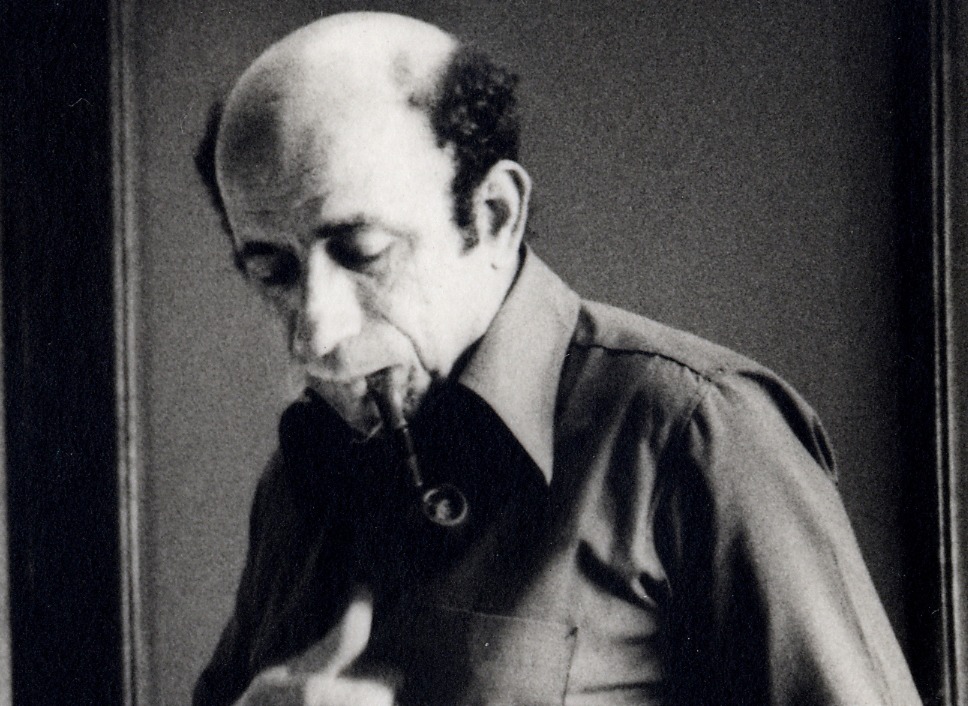
Khalil Khoury
Growing up inside that universe — sleeping in beds his father had designed, studying at desks his father had made, living in buildings his father had conceived — gave the young Khoury an idealized notion of what architecture could be. It was a standard that would take years, and considerable pain, to reconcile with reality.
Khalil’s story, however, is not without its shadows. Interdesign, the building he conceived in 1973 to showcase his life’s work — a structure as ambitious and singular as everything else he touched — never served its purpose. Construction began in 1975, stopped in April of that year when the civil war broke out, stuttered briefly in the early 1980s and was eventually completed in the post-war years, by which time the economic landscape had shifted irrevocably against the productive industries Khalil had built his life around. The company went bust. The building was seized by the bank. It sat in a state of latency for half a century.
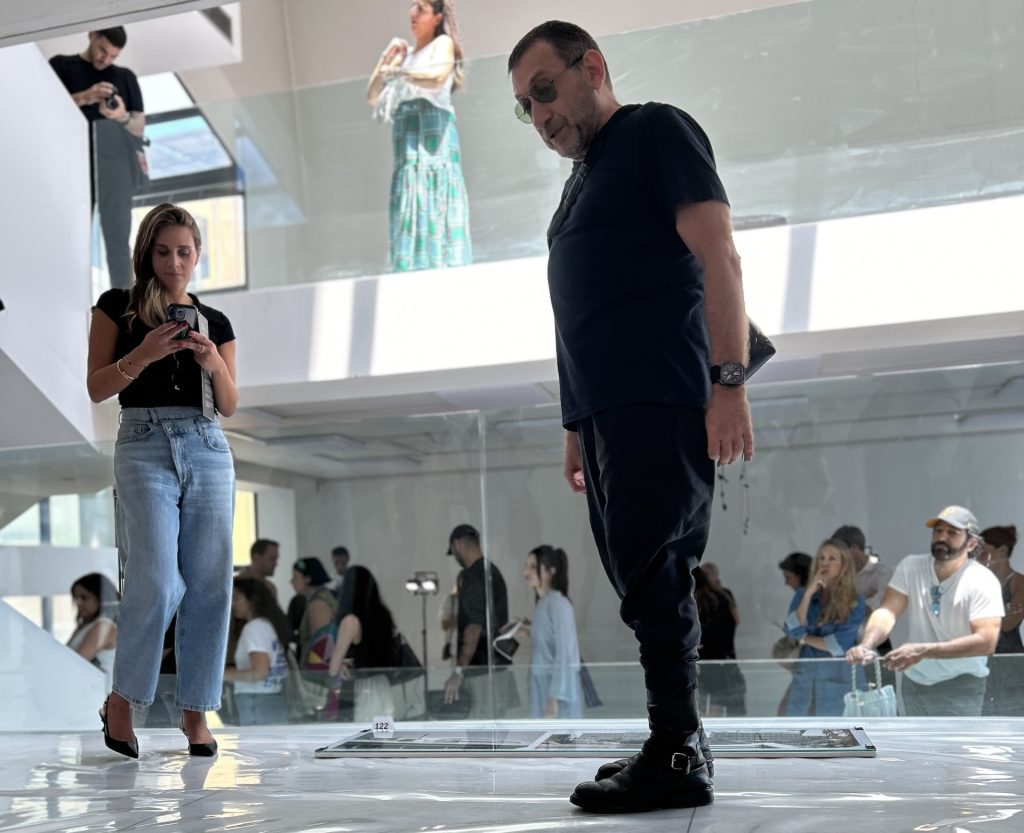
Interdesign exhibition, part of We Design Beirut 2024
In 2024, Khoury and his son Teymour restored it for a four-day event — not a design show, but something far more layered. “It was really the story of an impossible modern project,” he says. “The project is political at the end of the day.” Behind the furniture and the sleek mid-century lines was a meditation on Lebanon itself — on the 30 glorious years during which a generation believed they were building a modern nation, and on the failure of that dream. “We failed,” he says, without sentimentality. “The modern nation failed.”
Education and Life Abroad
When the time came to choose an academic path, Lebanon was deep in the throes of civil war. Khoury left for the United States, enrolling at the Rhode Island School of Design (RISD) before going on to Harvard’s Graduate School of Design — seven years of education completed in one unbroken stretch, far from a father who, characteristically, never once looked at what his son was doing. “Schools didn’t mean much to him,” Khoury says. “And he was absolutely right.”
It was an art school formation before it was an architectural one, and that distinction matters. The experimental methods, the willingness to begin with abstraction, the refusal to be bound by convention — all of it traces back to RISD’s fine arts foundation. Yet the reality of architecture school, and the career it seemed to promise, was a long way from the idealized vision of a boy watching his father bend wood with custom-built machines.
He returned to Beirut in 1993, fresh from Harvard, armed with ideas and no professional experience whatsoever. The early years were brutal. Sixteen commissions came his way — secured largely through social connections and the reflected prestige of his father’s name and his own academic credentials. None of them were built. “It doesn’t matter who your father is,” he says. “It doesn’t make you an architect. It doesn’t matter where you graduate from, it doesn’t make you a great architect either.”
What kept him afloat during those years was his father — not through advice or guidance, never that, but through the practical support of a studio space within the family factory, access to the manufacturing workshops for models and prototypes, and a financial safety net that, unknown to Khoury at the time, was itself already fraying. The factory was going bust.
The Turning Point – Project 17
Project number seventeen changed everything.
The early drawings for what would become B 018 were, by Khoury’s own admission, wildly conceptual — not remotely the kind of thing you would present to a client or contractor as a realistic proposition. They were abstractions, explorations, the beginning of an idea rather than the blueprint for a building. It was Naji Gebran, Khoury’s cousin and the music guru who would go on to run the club, who saw the drawings, grasped their potential and issued a challenge: “You have no guts. Your dad has more guts than you!”
Khoury’s father, the man who had never once set foot in his son’s studio within the factory, looked at the drawings, listened and said: “If you build this, build it. Build what you have right here. Don’t make any compromises.”
Then he sold the last piece of land the banks had not yet seized and handed his son the money to begin.
B 018 opened in 1998, sunk into the earth of Beirut’s Karantina district — a neighborhood carrying one of the civil war’s most painful memories, the site of a massacre of Palestinian, Kurdish and southern Lebanese refugees in 1976. Khoury did not flinch from that history, rather he metabolized it. The club was buried underground like the past beneath it, its coffin-shaped seats and retractable roof — which opens hydraulically in the early hours to expose the dance floor to the Beirut sky — making no attempt to prettify or forget. “Any morally responsible architect would have turned his back on such an absurd proposition,” he said. But then again, Khoury isn’t any sort of architect.
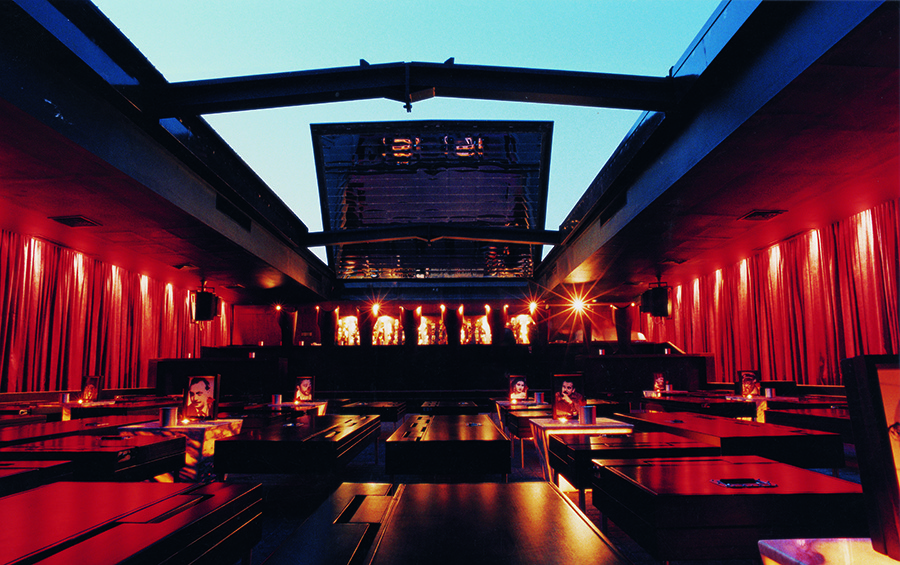
The international media response was instantaneous and overwhelming. CNN, the New York Times, the Washington Post — the coverage went far beyond architectural journals. Khoury was not yet 30 years old. “It goes to your head,” he admits, characteristically clear-eyed about why it flew. The Western media, he argues, was drawn to the sensational story, to the violence and the darkness, to the narrative they could package and disseminate quickly. “I became the bad boy who dances on graves,” he says. “And that story sold incredibly well.”
He rode the wave — and then, with equal deliberateness, stepped off it.
Beyond the Bunker
The hospitality projects that followed — Centrale, Yabani and others — continued to mine Beirut’s post-war contradictions, each one a carefully constructed situation in which the absurdity of the city’s denial was staged and celebrated in equal measure. Yabani, built on the old demarcation line next to a ruin squatted by refugees living without running water, placed its gleaming, aluminum-clad dining room in deliberate, violent contrast with what existed literally next door. “I was constructing a situation,” he says, “staging people into this situation. Not cynically, because I was also part of that.”
However, Khoury was always conscious of the limits of sensationalism, and when he felt the media appetite becoming a trap — when critics began demanding more of the same — he closed that chapter. “I’m not giving you more,” he told them. “We’re going to do something else now.”
What followed was a body of work that is, in many ways, more complex and more quietly radical than the projects that made his name. Residential buildings, institutional commissions, international work — all bearing the unmistakable Khoury signature, the refusal of the consensual, the obsession with specificity of place and political honesty.
His mother, he notes with quiet pride, was the first female architect registered in the Order of Engineers of Lebanon. Architecture, it seems, ran in the family from every direction
Stitching It Back Together
On 4 August 2020, the port of Beirut exploded. Plot #1072, Khoury’s residential tower, was the closest residential structure to the port hangars. Less than 200 meters from the perimeter, with no obstacle between them. The imported aluminum composite cladding was largely stripped from the building’s frame. Electromechanical systems were gone. Three residents died. It was, he says, a miracle anyone survived.
He proposed not to restore the building as it was, but to rethink it entirely — and to do so using exclusively local materials, local labor and local currency. “Labor is local currency,” he told the co-owners. Every element of the new facade would be produced in Lebanon, from raw materials transformed on-site, generating hundreds of thousands of hours of skilled work at a moment when the construction industry had collapsed and workers desperately needed employment.
The design itself emerged not from the drawing board but from mathematics. His team surveyed every panel of the damaged facade, cataloging each one according to the pattern of damage the blast had inflicted. A program was written to connect the data points — the vertexes of each damaged panel — and draw lines between them. The result was an intricate, unexpected mesh of stitches across the entire surface of the building: a pattern generated not by the architect’s hand but by the force of the explosion itself.
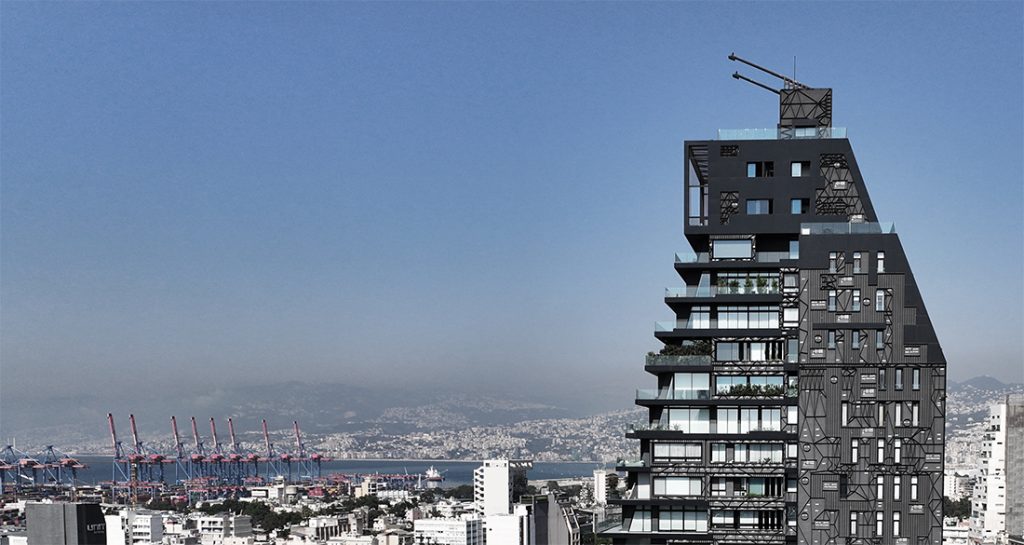
“I didn’t draw them,” Khoury says. “They’re pure mathematical results of connecting the vectors, which are a result of the different forces of the blast.” The stitching cost considerably less than a conventional restoration would have. And it tells, for those willing to look closely enough, the full story of what happened here — not erased, not prettified, but worn openly, like a scar that has healed with dignity.
Armenia, Iceland and the Work That Travels
Beyond Lebanon, Khoury has found in Armenia one of the few territories where he feels he can work with the same depth and freedom he has in Beirut. Through a long relationship with TUMO, the pioneering creative learning centers, he has completed a series of buildings that he counts among his most accomplished work outside Lebanon. His mother, now 97 and living in Miami, is Armenian; the connection to that culture runs deep.
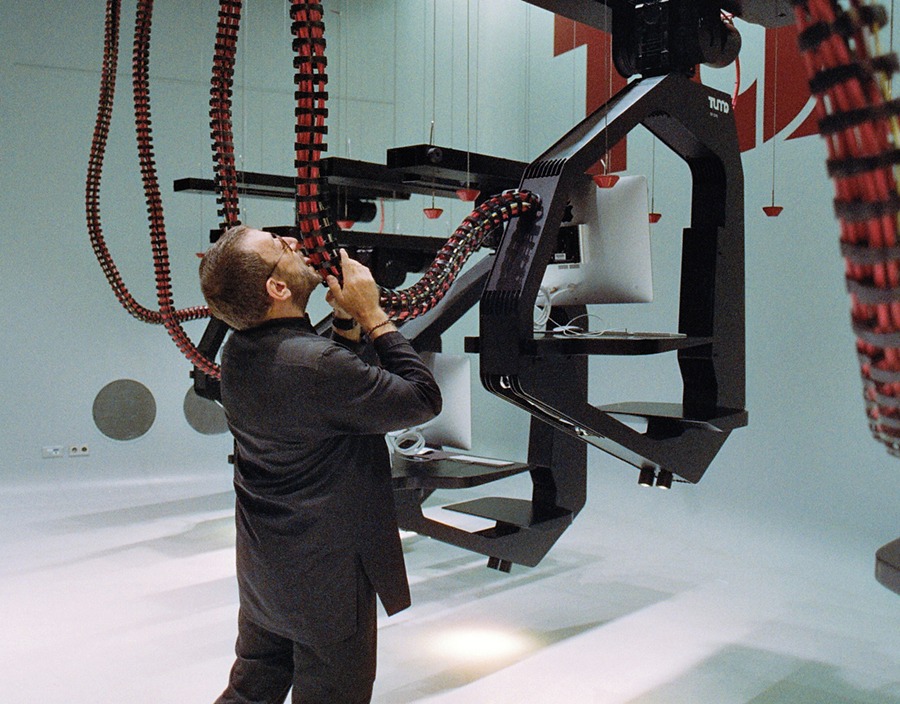
TUMO Paris
Meanwhile, a solo exhibition currently running in Iceland presents something altogether more unusual: a staged investigation into Bernard Khoury himself. The show takes the form of a court case — a fictional but meticulously constructed inquiry into the contradictions, inconsistencies and provocations of his work and his positions, resulting in the banning of a book he wrote. The sealed manuscripts sit on desks. The case notes cover the walls. Over 150 specimens of his projects are deconstructed, cross-examined and found wanting. It is, characteristically, both an act of radical self-criticism and a deeply theatrical piece of work. It will travel after Iceland.
The Bunker Returns
And then there is the homecoming. B 018 is reopening. After years in which the club drifted from its original spirit — becoming, in Khoury’s view, too mainstream, too commercial, too far from the singular musical vision that had made it legendary — it is being rebooted from the ground up. The hydraulics are being restored bolt by bolt. The original decor is coming back exactly as it was. Gebran’s son, Omran, will carry the musical torch his father once held. Khoury is behind him every step of the way.
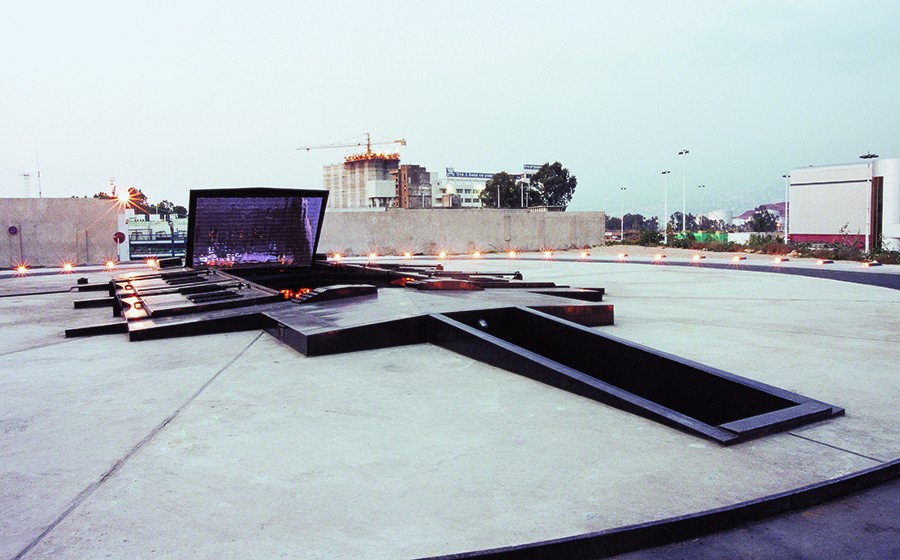
“The glorious years,” Khoury says, “stop in 2005.” What is coming in mid-June 2026 is not a nostalgia exercise. It is a return to first principles — to the raw, underground spirit of a place that was never just a nightclub, and that Beirut, right now, needs more than ever.
If you enjoyed reading this, check out the untold story of B 018.
Loading