




Some people arrive in a room and fill it entirely, not with noise but with presence. Milia Maroun, known to the world as Milia M, was one of those rare souls. Born and raised in Beirut, she went on to become one of the most distinctive voices in Lebanese fashion and a genuine pioneer among women designers from the Middle East.
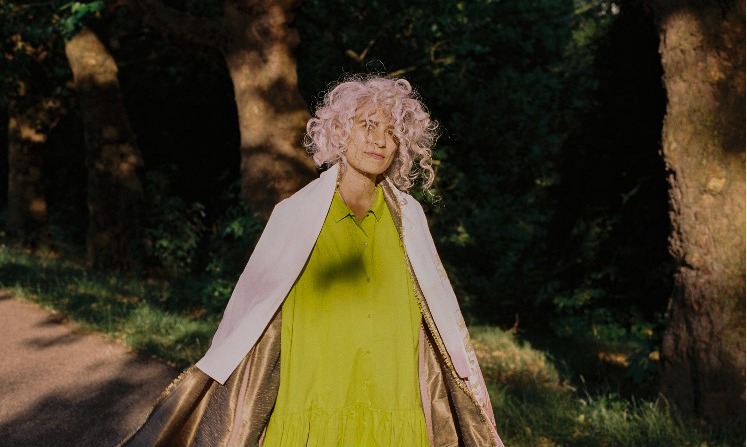
Origins and formation
Maroun left Beirut to study fashion design at ESMOD in Paris, one of the world’s most demanding fashion schools — an early sign of the ambition and seriousness that would come to define her. After graduating, she spent time as a lingerie designer, developing an intimate understanding of the female form, of comfort, of the quiet relationship between a woman and what she wears. That foundation never left her work.
In 2000, she launched her own label: Milia M. What made her debut remarkable was a deliberate and principled choice — to begin in ready-to-wear pieces rather than couture at a time when the region’s fashion world was largely organized around the grand gesture of the bespoke. She believed in accessibility and in femininity that did not require ceremony. She believed that beautiful clothes should be worn, lived in, carried through the world.
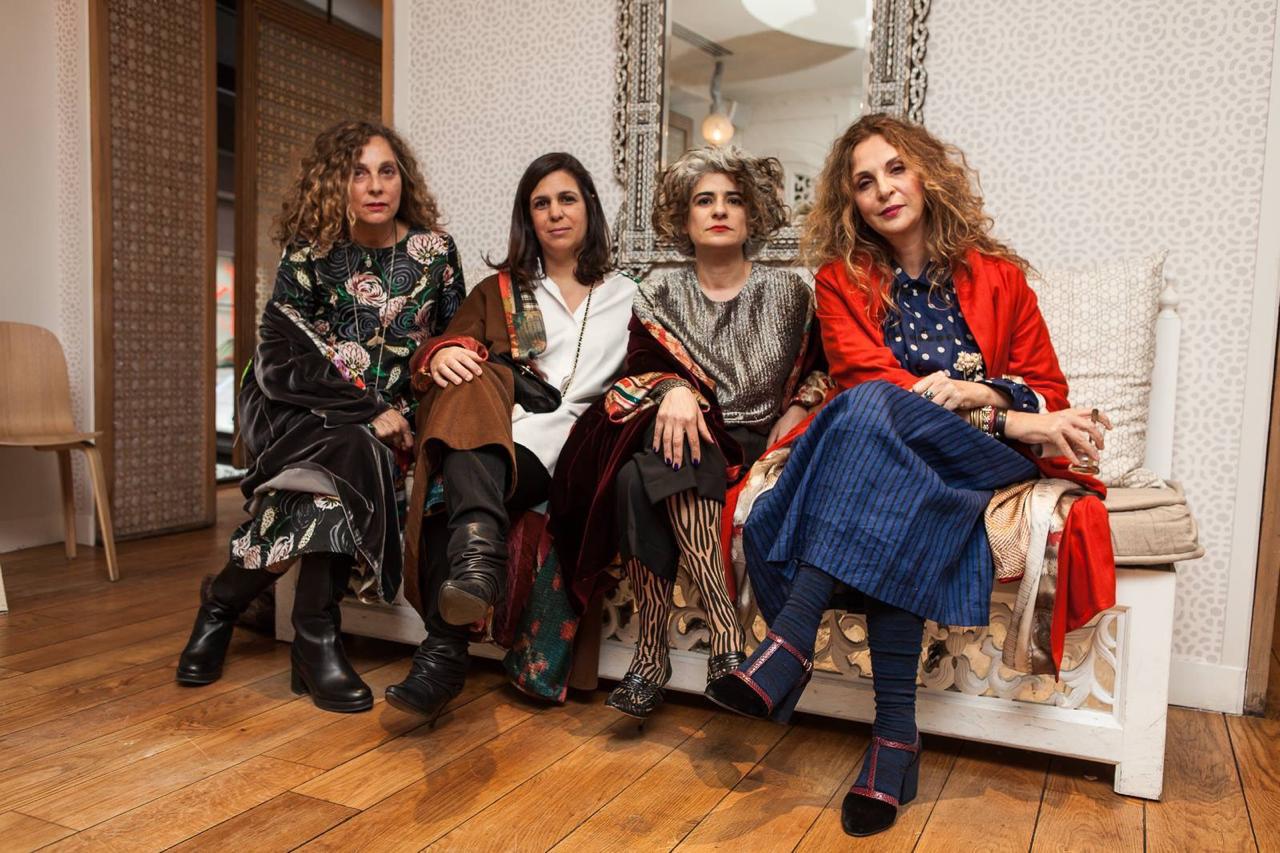
Milia Maroun with Huda Baroudi and Maria Hibri (taken from L’Orient Le Jour)
“Milia was the moon and the sun together — light and shadow, softness and force. Milia probed, challenged and questioned. Milia never settled. Her work pursued the quintessential, carrying a deceptive simplicity shaped through care, sensitivity and precision,” say Huda Baroudi and Maria Hibri, the design duo behind Bokja. The pair collaborated with Maroun on a Kimabaya collection, an experience they say was immense fun. “We had a blast. We played and laughed,” Baroudi and Hibri recount.
A Life of Cities and Cultures
To understand Maroun’s work is to understand her restlessness. She moved through cities the way her designs moved with the body. From Beirut to Paris, Damascus to Istanbul and London, each city left its mark: the discipline of Paris; the layered history of Damascus; the crossroads energy of Istanbul; the rigor and openness of London, where she eventually established her studio in 2016. Her designs carry it all and more — a multiculturalism present in every seam.
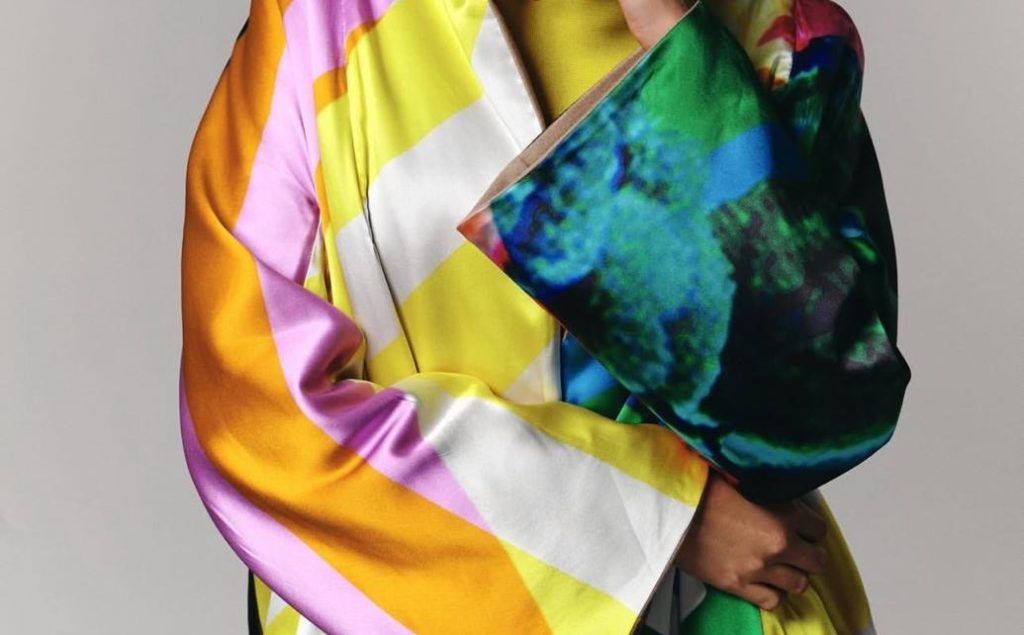
Milia M x Rana Salam collaboration
The Work
Milia Maroun was a multi-disciplinary designer in the truest sense. Her practice crossed freely between fashion, art and conceptual design. Her early leather jackets were already the stuff of legend within the Lebanese creative community: singular objects, instantly recognizable, coveted by designers and collectors alike. Then came the Kimabayas.
The Kimabaya — her signature garment, a hybrid form drawing on the abaya and the kimono — became the fullest expression of her vision: a garment at once culturally rooted and entirely her own, modest and fluid, deeply wearable and quietly radical. Many were produced in collaboration with artists, craftspeople and fellow designers — Bokja, Nada Debs and Rana Salam, among others — and exhibited in galleries and boutiques around the world. The Kimabaya was not merely a piece of clothing; it was a statement about where fashion could go when it listened to the past without being imprisoned by it.
Between 2004 and 2016, from her Saifi Village flagship — the beating heart of Beirut’s creative quarter — she built a label and a community. Collections shown at the inaugural Abu Dhabi Fashion Week in 2007 and at Milan Fashion Week in 2008, announced her to the world beyond Lebanon.
“Milia was a force of nature. She was larger than life. The only thing that was not big about Milia was her size. Everything was big: her smile, her laugh, her hair, her talent. Big, big, big. Big on life, big on joy, big on friends. A rainbow in every sense of the word. For the creative community, the loss is great,” says designer Samer Al Ameen, a long-time friend of Maroun.
Art and Exhibition
Fashion was never quite enough to contain her. Maroun moved naturally into the world of exhibition and conceptual design, showing work at some of the most distinguished institutions in the world. The International Design Biennale at Saint-Étienne (2004), the Haus der Kunst in Munich (2010), the Villa Empain in Brussels (2012) — these were not fashion showcases. They were testaments to a designer thinking at the intersection of object, idea and culture.
In 2015, the Beirut Art Centre gave her a solo exhibition: “Now/Here” — a title that captured something essential about her practice, always alert to the present moment, always exactly where she needed to be. Two years later, Beirut Design Week hosted “Object Permanence — Objeu Collection,” a body of work that played with the philosophical concept of permanence, asking what objects mean, what they carry, what they leave behind.
“Milia was greater than life. She had a philosophy of living that touched everything around her — the way she dressed, the homes she created, the people she surrounded herself with. There was a rare coherence between who she was and how she lived, and I always admired that deeply. She was immensely talented, yet never loud about it. Everything she did felt instinctive, personal and true to herself. She is someone one cannot forget,” says designer Nada Debs.
In 2016, Maroun and Debs collaborated on the Kimabaya exhibited at the Institut du Monde Arabe. The piece naturally carried Maroun’s spirit. It was inspired by the idea that Japanese fashion designers approach the body through its skeleton, while Western fashion often emphasizes the muscles and curves of the body. The line of mother-of-pearl running down the back of the Kimabaya was conceived like a spinal column — “a quiet but powerful presence, much like Milia herself,” says Debs.
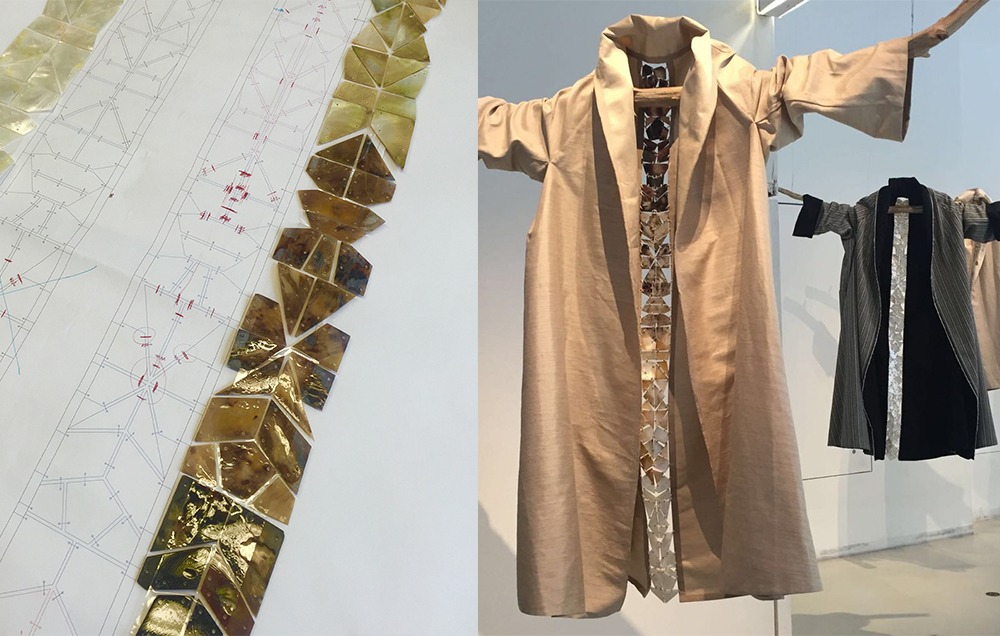
Milia M x Nada Debs collaboration
Milia Maroun’s Legacy
Those who knew Milia Maroun speak consistently of one thing above all: her warmth. She was generous with her time, her encouragement and her enthusiasm for other people’s work. In a competitive industry, she was known for cheering others on without reservation. She made people around her feel seen, capable and motivated to keep going.
Designer Rana Salam recalls the last message with her friend. “I texted Milia. Her reply was: ‘Habibté — thank you for your words. You inspirational mind. Keep walking.’ That was how she approached life. Always positive, always moving, always optimistic. ‘Keep walking’ was not a throwaway sign-off. From Milia, it was a directive.”
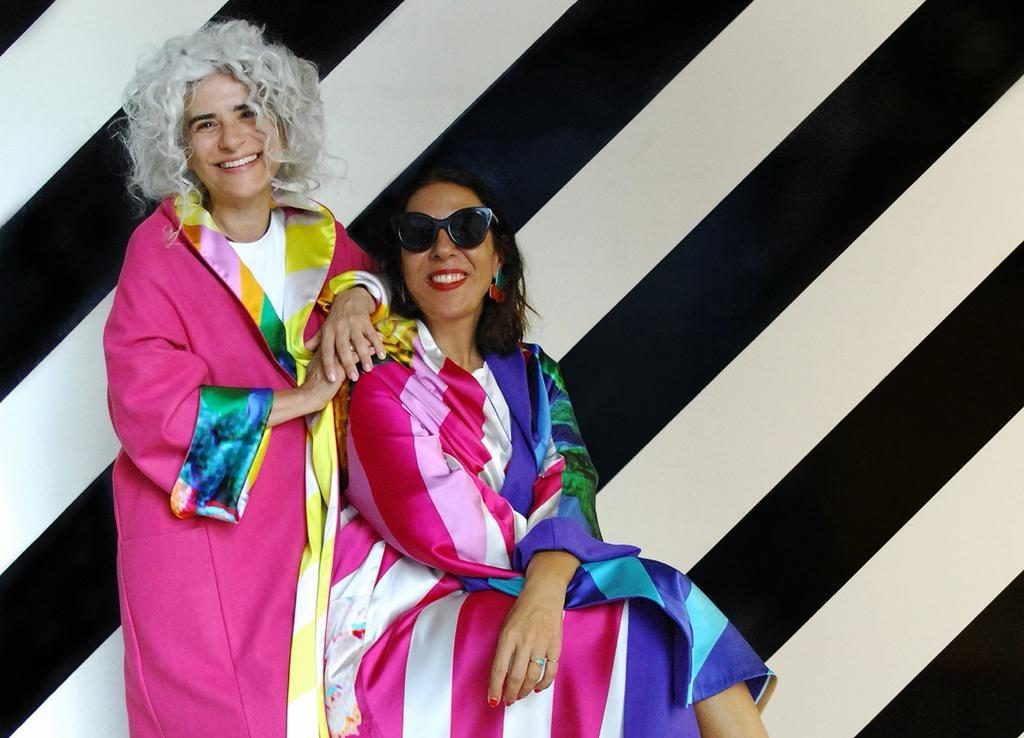
Milia Maroun and Rana Salam
It is fair to say that Milia Maroun leaves behind two legacies. The first is her body of work: over two decades of womenswear, internationally exhibited Kimabayas and conceptual design shown at major institutions from Munich to Brussels — a practice that consistently moved between fashion and art.
The second is harder to measure. She was one of the first designers from the region to build a ready-to-wear label from the ground up, without the scaffolding of couture — proving that Lebanese design could be global, accessible and intellectually serious at the same time. For the designers who came after her, that example endures.
Beyond the professional, she leaves behind a community of people — collaborators, friends, fellow creatives — who describe her influence in deeply personal terms. Not as a mentor in a formal sense, but as someone whose belief in others had a lasting effect. One that those who knew her will carry forward. “She leaves behind a luminous imprint that will continue to stay with us,” say Baroudi and Hibri.